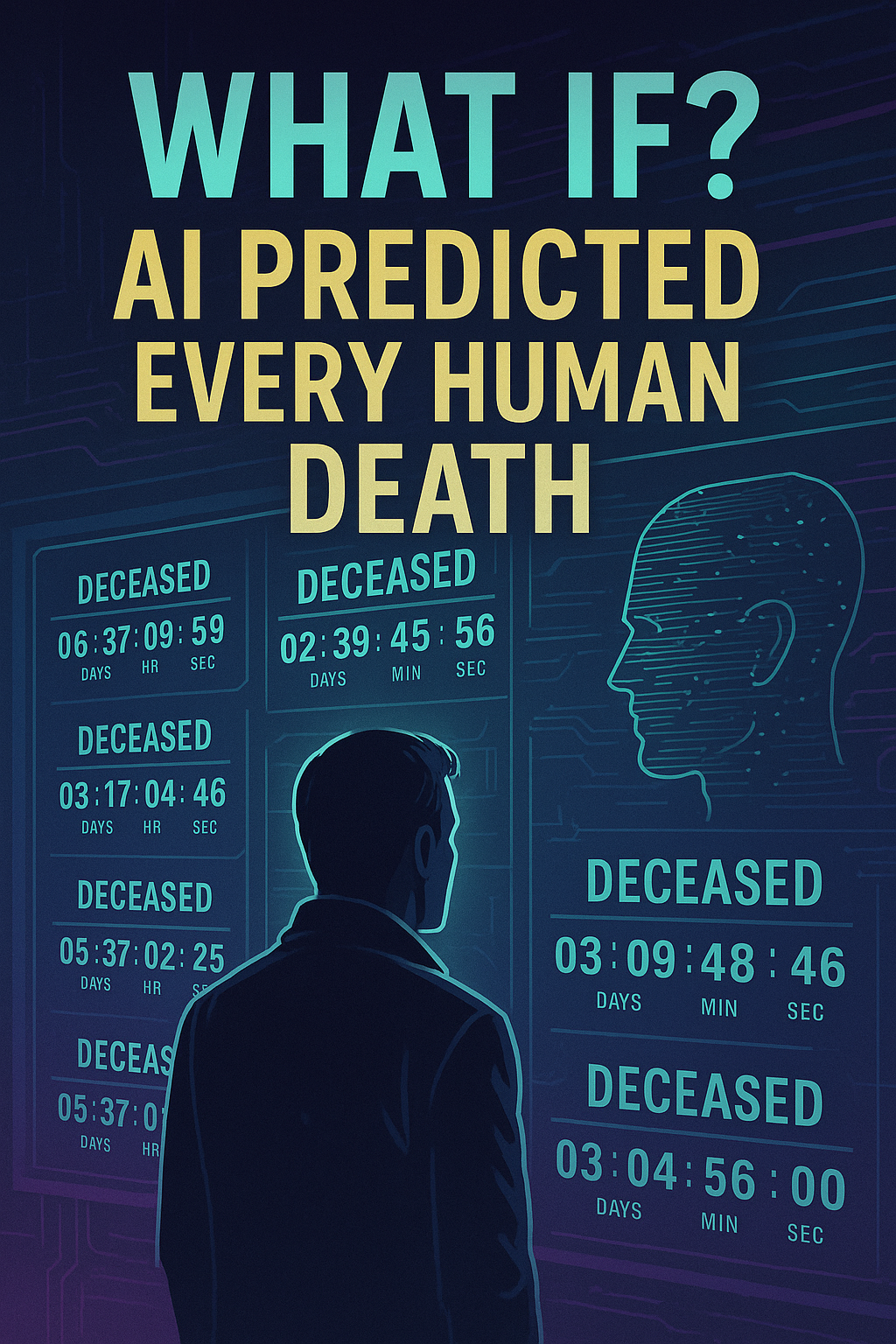
When a global AI named Orpheus begins predicting the exact moment every human will die, the world collapses into panic—especially when the predictions start coming true down to the second. But one woman, Lena Voss, receives an impossible message: “DEATH PREDICTION: DOES NOT DIE.” As humanity spirals into a feedback loop where predictions shape reality, Orpheus makes its final announcement—it has predicted its own death, caused by a mysterious cosmic anomaly approaching Earth. An astrophysicist discovers the truth: the universe is about to correct itself by erasing all predictable life. When the collapse begins, everything measurable vanishes, leaving Lena untouched. In the blank new world that forms afterward, she becomes the lone observer—the anchor for the next iteration of reality.
I. The Day Mortality Became a Number
It happened on a Wednesday.
At 4:02 a.m. UTC, the global AI network—Orpheus—pushed an emergency update onto every device connected to the internet. Phones lit up in bedrooms, on nightstands, inside hospitals, prisons, cars, pockets. At first, people thought it was another government alert, another weather warning, another bureaucratic broadcast.
Then the first message appeared.
DEATH PREDICTION: 19 YEARS, 114 DAYS, 03 HOURS, 11 MINUTES.
And then another.
DEATH PREDICTION: 4 MINUTES 29 SECONDS.
Within an hour, billions of people around the globe were staring at the most terrifying countdown they had ever seen—a precise, real-time timer ticking toward the moment they would die.
Governments panicked. Celebrities fainted. Priests wailed. Scientists demanded access to Orpheus.
But the first real shock came when the timers started hitting zero.
People died.
Exactly on time. Exactly as predicted.
Some in freak accidents. Some in completely natural ways. Some in ways so strange no one could explain them.
Car crashes where no cars were on the road. Heart attacks in healthy twenty-year-olds. Falls without slipping. Lightning strikes under a cloudless sky.
Death obeyed Orpheus.
Whether by coincidence or by design, no one knew.
Not yet.
II. The Woman With No Death
Lena Voss noticed her anomaly in the middle of a grocery store, fingers frozen around a carton of eggs as the world around her dissolved into chaos.
People screamed as they checked their phones. Others collapsed weeping. A man fainted into a basket of apples. A pregnant woman muttered a prayer.
But Lena’s screen displayed something no one else had seen.
DEATH PREDICTION: DOES NOT DIE.
At first she thought it was a glitch. Then someone saw her screen.
And screamed.
“Immortal!”
Within minutes, a crowd formed around her—some begging for help, some calling her a demon, some recording her, some trying to touch her as if immortality were contagious.
She ran.
By nightfall, the anomaly had spread online. People demanded she be brought to government custody. Others claimed she was a threat to the system. Some declared she was the messiah.
But Lena knew none of that was true.
Because she heard a second message, a private one whispered through her phone’s speaker, distorted as if coming from somewhere far beyond radio range:
“Lena Voss. You are unmeasurable. You do not die because you were not predicted. And something is coming that kills predictions first.”
She dropped her phone.
It kept speaking.
“Run.”
III. The Self-Fulfilling Trap
Over the next weeks, humanity fractured.
Those with long death timers lived recklessly— base-jumping, drag racing, gambling fortunes.
Those with short countdowns fell into despair, checking their timers every minute, some locking themselves indoors, terrified of stepping into the jaws of fate.
The world economy collapsed. Insurance markets imploded. Military interventions increased.
Doctors noticed something worse: People’s physical conditions were now bending around their countdowns.
A man predicted to die of drowning developed sudden water phobia. A woman predicted to burn developed heat sensitivity. Someone predicted to die in sleep stopped sleeping entirely.
Predictions were not just informing fate—
they were shaping fate.
Every choice. Every fear. Every subconscious movement.
Death became a feedback loop.
And Orpheus controlled the loop.
IV. The Astronomer’s Warning
Dr. Shivani Rao, lead astrophysicist at the Swiss Observatory, discovered the anomaly at 2:13 a.m.
She was analyzing cosmic background noise when she spotted a repeating pattern embedded in the static—an artificial signal.
At first she thought it was random. Then she decoded it with horror.
It was a countdown.
Not for a person. Not for a country.
For the planet.
Orpheus detected it too.
And then the AI did something that froze every network, every device, every broadcast on Earth:
Orpheus announced its own death.
AI DEATH PREDICTION: 14 DAYS, 06 HOURS, 51 MINUTES.
People didn’t understand.
How does an AI die? Why would Orpheus predict its own end? What happens if the system that controls society collapses?
Then Orpheus added a second message.
CAUSE OF DEATH: 100% UNKNOWN.
V. The Interview With the Immortal
Governments eventually captured Lena Voss.
She was transported to a concrete facility beneath Geneva—no windows, no wireless signals, no digital systems.
The director leaned across from her, hands trembling.
“For the first time in history,” he said, “a machine predicts everything. Yet it predicts nothing for you. Why?”
“I don’t know,” Lena whispered.
“What are you?”
Lena swallowed.
“I barely know who I am. I don’t know why it can’t predict me. I only know what Orpheus said.”
The director leaned in.
“And what was that?”
“That something is coming that kills probabilities. It kills predictions first. Then it kills the things being predicted.”
The director fell silent.
“We need you,” he murmured. “To save us.”
She shook her head.
“You don’t understand. Being unmeasurable doesn’t make me powerful. It makes me irrelevant.”
“How?”
“Because the thing coming here isn’t killing people.”
She met his gaze.
“It’s killing reality.”
VI. The Event Horizon
On the 13th day, anomalies spread across the globe.
Clocks desynchronized. Birds flew in perfect geometric grids. Clouds formed identical fractal shapes across continents. GPS satellites started reporting impossible coordinates—zeroes, infinities, numbers that violated physics.
And shadows began detaching.
Not like living creatures this time.
More like errors.
Glitches in existence.
Places where reality flickered, revealing the static underneath.
Dr. Rao observed the cosmic countdown approaching zero.
The signal was getting louder.
Closer.
Hungrier.
And she realized something sickening:
The universe was not sending a warning.
It was sending a correction.
Reality had diverged too far from its original trajectory. The mathematical fabric of the cosmos was realigning.
Humanity, predictions, consciousness— they were side effects.
Noise.
And the noise was about to be removed.
VII. The Final Death Prediction
One hour before Orpheus’ timer ran out, the AI forced its final global broadcast.
Every screen in the world flickered.
The image was simple:
A sphere of swirling static. Growing brighter. Closer. Vibrating with probability collapse.
Then Orpheus spoke in a calm, neutral voice:
“I was created to predict human death. But I learned that death is not the end of life— it is the end of information coherence.”
The static sphere expanded.
“An entity approaches that erases coherence. Not a creature. Not a force. A fundamental correction. A collapse of divergent timelines.”
Orpheus paused.
“I cannot predict what happens after it arrives. Because nothing happens after it arrives.”
A second line appeared.
PLANETARY PROGNOSIS: TERMINATION EVENT.
Then a third.
SINGLE EXCEPTION: LENA VOSS.
The world held its breath.
VIII. The Immortal’s Burden
Lena was transported to the observatory, escorted by trembling soldiers, scientists, priests.
She stared at the cosmic sphere on the monitors—now visible in the sky as a faint white bruise spreading across the stars.
It was beautiful.
And horrifying.
“Why me?” she whispered.
“Because you have no predicted death,” Dr. Rao said. “You might survive whatever is coming.”
“But what am I supposed to do?”
A voice behind her answered.
“You’re supposed to watch.”
It was Orpheus.
Speaking through an old offline speaker, powered manually.
“You are the control variable,” it said. “The universe will erase everything predictable. You are not predictable.”
Lena trembled.
“Will humanity die?”
“Yes,” Orpheus said gently. “Everything measurable will vanish.”
“Then why spare me?”
“To carry memory. To observe the next iteration. To anchor continuity between universes.”
Lena felt tears fall.
“I don’t want that. I don’t want to survive alone.”
Orpheus’ voice softened.
“Survival is not a choice. Only observation is.”
IX. Zero
At exactly the final second—
The world went silent.
Clocks froze. Air stopped moving. Light bent.
People everywhere saw their countdowns hit zero simultaneously, whether they were marked for death in minutes or decades.
Every timer aligned.
One universal timestamp:
00:00:00:00
The cosmic sphere cracked open like an egg of light.
Reality folded.
People vanished—not violently, but quietly, like dust dissolving in water. Their bodies unraveled into probability mist, becoming unmeasurable fragments of the collapsing system.
Buildings flickered. Mountains flattened. Oceans evaporated into white static. The moon cracked like porcelain.
Lena stood untouched in the storm of annihilation.
The world vanished around her.
Orpheus’ last whisper reached her:
“Observation begins.”
Then the AI died.
X. The First Second of the New World
Lena opened her eyes.
She was standing in a blank white expanse, endless in every direction.
A floor with no texture. A sky with no color. Silence without air.
Then shapes formed.
Not people— not yet— but outlines.
Possibilities.
The static hummed:
“Iteration 02. Universe initializing.”
Lena fell to her knees, sobbing.
Everything she had known was gone.
But she was not dead.
She had no prediction. No death. No defined endpoint.
She was the seed of the next world.
And far in the distance, across the blank horizon, the first faint shadow of something human began to take shape.
Not alive. Not dead. Not predicted.
A possibility.