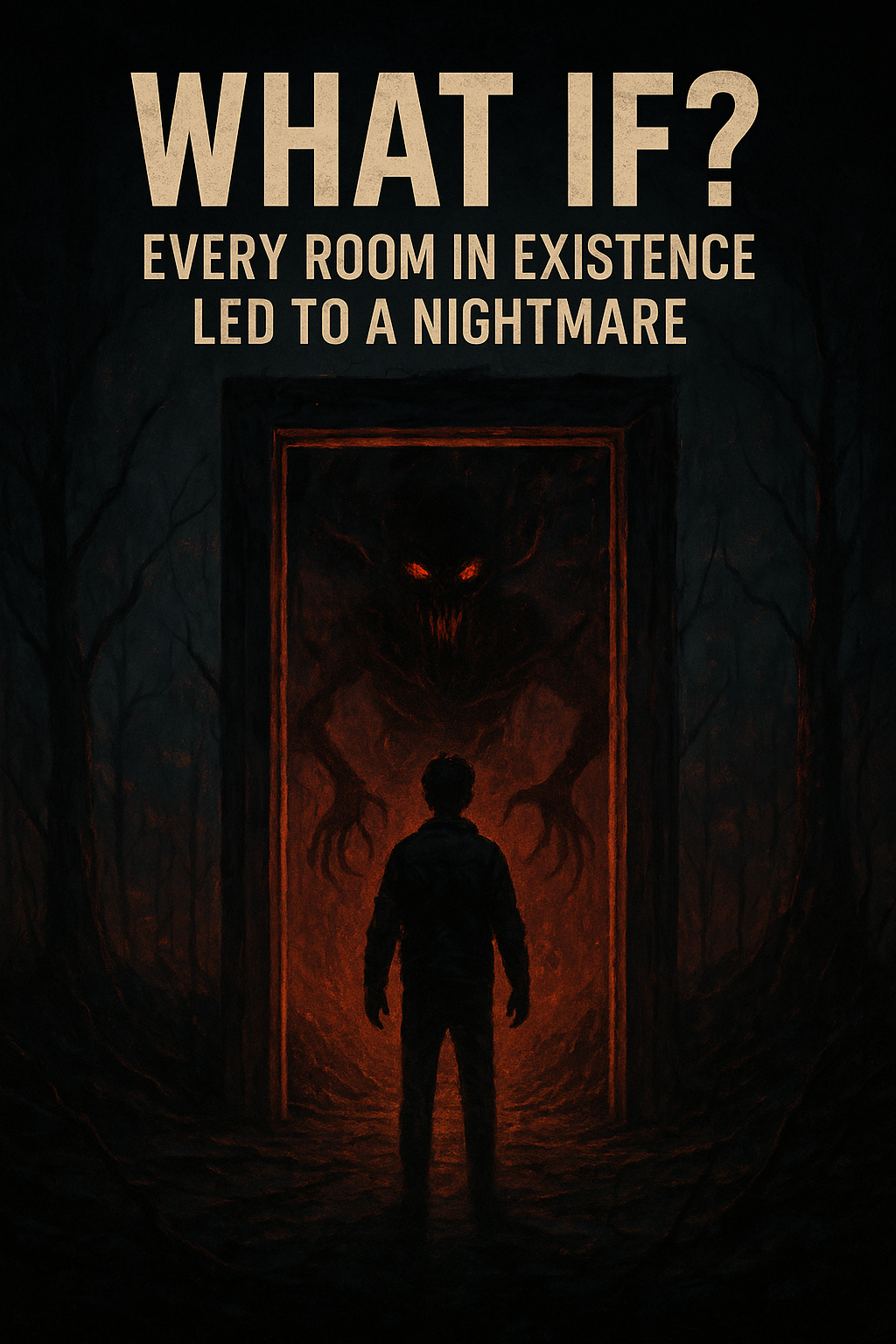
When every room on Earth becomes a portal to a personal nightmare, humanity abandons all architecture and lives outdoors to avoid stepping across deadly thresholds. Mira Lang becomes the only known survivor to enter a nightmare and return, making her key to understanding the phenomenon. As scientists learn that nightmares manifest whenever a person crosses any type of boundary, even conceptual ones, the horror spreads beyond physical rooms. Nightmares start entering reality—through Mira. To stop the world from collapsing into a single infinite nightmare, Mira confronts the first room she ever feared: her childhood bedroom. By facing her deepest trauma, she breaks the cycle and restores normal space. But she realizes the nightmares aren’t gone—they’re simply waiting for humanity to cross the next boundary.
I. The Night the Doors Changed
It happened at 2:14 a.m., when most of the world was asleep and the only people crossing rooms were insomniacs shuffling to bathrooms, night-shift workers reaching break rooms, and parents checking on their kids. At first, no one understood what was happening. A man in London stepped into his kitchen and vanished. A teenager in São Paulo walked into her bedroom and never returned. A nurse in Chicago pushed open a supply closet and began screaming so violently that the entire hospital evacuated.
By dawn, millions were missing.
By noon, the truth emerged.
Every enclosed room in existence—every bedroom, bathroom, office, car interior, elevator, closet—had become a doorway to a personal nightmare.
You could hear the victims.
Some screamed. Some begged. Some clawed at the walls of rooms that no longer led where they should. Some simply went silent.
No one who crossed a threshold returned.
The world panicked. Doors were barricaded. Walls smashed. Cities tore buildings apart with forklifts and cranes. Highways filled with abandoned vehicles when people realized that stepping into the enclosed space of a car was as dangerous as stepping into a shark’s mouth.
By the evening of Day One, humanity had already changed how it lived.
No more closed doors. No more rooms. No more shelters.
Everything indoors had become a trap.
II. Seven Days in the Open
By the end of the first week, civilization looked like a sprawling campsite. People dragged mattresses into parking lots. Families pitched tents on rooftops. Hospitals treated patients outdoors under tarps. Governments issued emergency broadcasts urging citizens to demolish internal walls or abandon buildings entirely.
Cities became open-air skeletons.
Apartment buildings were gutted to expose every floor. Skyscrapers were drilled open like hollow bones. Suburbs tore out living room walls so kitchens wouldn’t count as “rooms.”
And still… nightmares bled through.
Because no one understood the rule.
It wasn’t walls that triggered the nightmare. It wasn’t ceiling height or square footage.
It was crossing a boundary.
Any clear transition from one space to another—doorways, archways, thresholds—led to horror.
People began leaping through windows instead. Climbing roofs instead of using stairwells. Sleeping in streets because stepping into a house, even without walls, felt like crossing a line.
Humanity abandoned architecture in seven days.
But one person refused to abandon the mystery.
Her name was Mira Lang.
And she had seen what waited behind the doors.
III. Mira, the Last Survivor of a Room
Mira Lang was the only known human to enter a room and come back alive.
She didn’t walk out. She fell out—thrown violently through her own closet door, landing in a heap of shirts and blood.
When she regained consciousness at an outdoor medical camp, her throat was raw from screaming. Her fingernails were broken. Her forearms bore deep scratches as if she’d fought something with teeth sharper than knives.
But she lived.
Doctors asked her dozens of questions, but she couldn’t form words for days. Her mind was tangled with fragments—shadows, whispers, a creature that looked half like her and half like someone she used to trust. She remembered walls that pulsed like skin, and a floor that grew arms.
Yet the only word she muttered clearly was:
“Room.”
Doctors misunderstood, thinking she wanted a private area. They nearly wheeled her toward an ambulance—a death sentence—before she began screaming again.
When she finally calmed, Mira explained:
“I didn’t just enter a nightmare. It entered me.”
And that made her valuable.
Because Mira hadn’t escaped a nightmare.
She’d survived it.
IV. The Open-Sky Enclave
Two weeks after the Event, the government formed the Open-Sky Enclave—a research facility with no rooms, only platforms suspended by steel scaffolding. No ceilings. No walls. No boundaries.
Here, scientists studied the phenomenon. And here, they brought Mira.
She sat on a woven cot, wind chilling her skin, while Dr. Imani Liao whispered questions with the calm precision of someone who’d stopped believing in impossible things months before the world did.
“Mira,” she said softly, “what did you see?”
Mira swallowed, feeling the memory like a shard of glass under her ribs.
“It wasn’t a dream,” she murmured. “It wasn’t a hallucination.”
She lifted her trembling hands.
“It was a place. A real place. Alive.”
Dr. Liao tilted her head. “What was alive, Mira? Walls? Floors? Objects?”
“The fear,” Mira whispered.
Dr. Liao blinked. “Fear?”
“It took shape,” Mira said. “My fear. It formed itself around me. It knew everything I tried not to think about.”
Dr. Liao’s pen paused.
“And when I tried to escape,” Mira continued, “it changed the nightmare. It made new rooms. New scenes. It wouldn’t let me leave.”
“You did leave,” Dr. Liao said gently.
Mira shook her head.
“No. It let me go.”
V. The Terrifying Discovery
Three days later, Mira joined Dr. Liao and a team of scientists on the upper platform, overlooking a gutted office complex. Mira’s pulse quickened as she watched birds circle above the broken concrete.
A volunteer stepped toward the building entrance.
“Stop him,” Mira whispered urgently.
Dr. Liao nodded, signaling the team.
The volunteer halted inches from the doorway.
Not crossing it.
Mira felt her breath steady.
“That’s the line,” she said. “The threshold. The boundary.”
Dr. Liao approached her.
“You’ve mentioned boundaries before. Explain it again.”
Mira closed her eyes.
“When you cross into a space meant to be separate—meant to feel different—the nightmare takes you. Rooms, cars, bathrooms, old sheds… they were designed as separate worlds.”
Dr. Liao frowned. “Design implies intention.”
Mira nodded.
“Exactly.”
Dr. Liao’s eyes widened.
“You think nightmares are not random.”
“No,” Mira whispered. “They’re architectural.”
VI. The Cartographer of Nightmares
Dr. Liao began experimenting with “boundary tests.”
A chalk line on a sidewalk. A piece of string tied between two poles. A hoop taped to the ground.
Volunteers stepped across them one by one.
Each vanished.
The world changed in an instant.
Nightmares were not tied to rooms. They were tied to the concept of entering a new space.
Spaces didn’t need walls. They didn’t need roofs. They didn’t need doors.
They only needed definition.
And humans defined spaces unconsciously.
Going from inside to outside. From courtyard to garden. From street to driveway. From one grassy area to another separated by a fence, a path, a difference in texture.
Any shift in environment could become a boundary.
Nightmares were everywhere.
Humanity had only delayed the inevitable.
VII. The Nightmare That Followed
The researchers celebrated their breakthrough, convinced it meant boundaries could be manipulated, controlled, erased.
Then Mira woke screaming one night, her hands covered in fresh scratches she hadn’t made herself.
“It followed me,” she sobbed. “It learned me. It can cross into the world now.”
Dr. Liao paled.
“You mean the nightmare escaped with you?”
“No,” Mira shook her head. “Just pieces of it. Echoes. Fragments.”
She looked at her hands.
“They’re becoming real.”
Dr. Liao held her.
“How long,” she asked softly, “until the nightmares don’t need rooms or boundaries at all?”
Mira didn’t answer.
She didn’t need to.
The screams rising from the lower platforms did it for her.
VIII. The Collapse of Separation
It spread faster than any virus.
People standing in the open began vanishing—no doorways, no walls, no lines drawn. Simply because their minds believed they were stepping from one state of being into another.
From safety into danger. From despair into hope. From past into future. From one identity into another.
The nightmare fed on conceptual thresholds.
First physical boundaries. Then psychological ones. Then emotional ones.
By sunset, even blinking felt dangerous.
Closing your eyes and opening them again felt like crossing a boundary.
People kept their eyes open until they bled. Others kept them shut until they starved. Some prayed their thoughts wouldn’t betray them.
But boundaries were everywhere.
And nightmares had infinite shapes.
IX. The Room That Ends the World
Dr. Liao summoned Mira to the highest platform—the one with the last working generator humming beside them.
“Mira,” she said shakily, “we believe your nightmare wants to recreate the first room you ever feared.”
Mira felt cold.
“My childhood bedroom,” she whispered.
Dr. Liao nodded.
“We’ve detected spatial distortions around you—forming that very room.”
Mira felt her breath shatter.
“And if it forms fully,” Dr. Liao continued, “it may become a template for the entire world. One room. One nightmare. No escape.”
Mira trembled.
“What do I do?”
“You go in,” Dr. Liao said softly. “You enter it willingly. You face it. And you break the cycle.”
A personal sacrifice. A final threshold.
The world’s last doorway.
X. Mira’s Last Room
The sky dimmed as Mira stepped toward the distortion forming in the air. A faint outline of her childhood bedroom doorframe flickered, shimmering with memories she wished she’d forgotten.
Her father yelling. Her mother crying. The shadows of her old home taking shapes she mistook for monsters.
She inhaled.
She crossed the boundary.
Darkness swallowed her.
The nightmare built itself around her—the wallpaper she hated, the creaking floorboard by the vent, the window where she used to imagine monsters staring back at her.
A figure formed in the corner.
Tall. Thin. Face shifting and melting like wax.
Her childhood fear made flesh.
“Mira,” it whispered, using her father’s voice. “You can’t leave this room.”
Mira stepped forward.
“I already left,” she whispered. “Years ago.”
The nightmare trembled.
“My fear didn’t trap me,” she said. “Your world did.”
The room shook violently.
She reached forward and touched the monster’s shifting face.
“You’re not my nightmare,” she whispered.
“You’re just a room.”
The world cracked open like glass.
Light poured through.
And the room collapsed.
XI. The Morning After
Mira woke on the upper platform of the Enclave, Dr. Liao gripping her hand.
“You did it,” the doctor whispered, voice hoarse. “The nightmares… they’re gone.”
Mira blinked slowly.
“Gone?”
“No more vanishings. No more thresholds. No more boundaries turning hostile.”
Mira exhaled deeply.
The sun rose.
People stepped across doorways. Entered houses. Closed doors. Opened them.
The world breathed again.
But Mira felt a weight in her chest.
Because she understood why the nightmare had vanished.
It wasn’t defeated.
It had learned.
And now it was waiting.
Waiting for the next boundary humanity would cross.
A room not made of walls— but of choices.