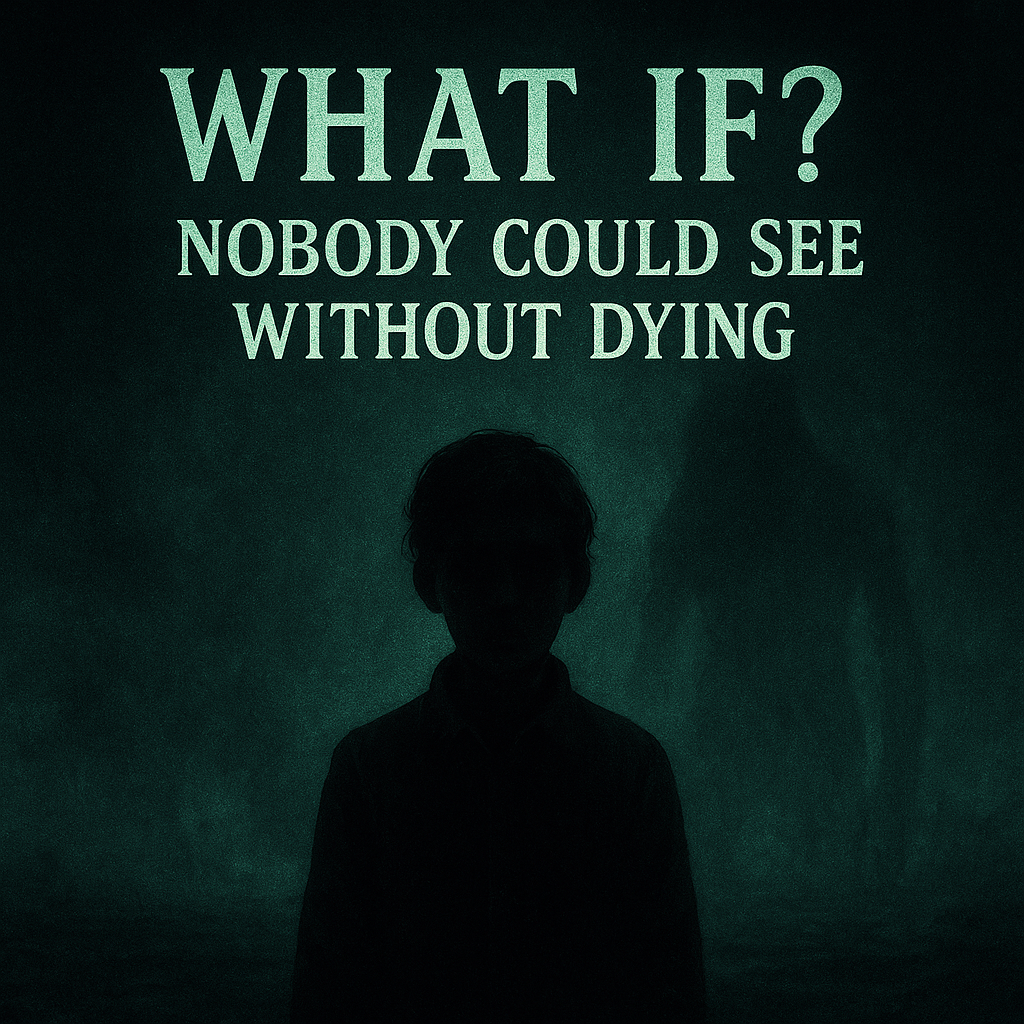
When simply opening your eyes causes instant death, humanity is forced to live in total darkness. A young girl named Elsie becomes the only person who can “see” the new world through a strange inner vision, revealing tall, invisible beings hiding everywhere. A survivor named Maddox arrives immune to the deadly effect of sight, and together they uncover the truth: the creatures aren’t killers—they’re fugitives hiding Earth from a far worse entity that hunts anything that sees it. When the cosmic predator draws near, Maddox confronts it with the only sight it cannot erase, saving humanity but vanishing in the process. The world regains its vision—but Elsie knows the monster will return.
I. The First Moment of Darkness
It started at 7:03 a.m. Eastern Time, during the sleepiest part of morning routines—coffee machines sputtering, alarms blaring, early risers stepping outside for a quick stretch before work. In a quiet suburb outside Boston, a woman opened her front door, blinked into the sunrise, and collapsed before her body hit the ground.
Across the world, commuters slumped over steering wheels. Runners fell mid-stride on their morning jogs. A child in Paris climbed out of bed, opened his eyes, and died instantly.
Everywhere, anywhere, whoever opened their eyes met the same fate.
Within minutes, emergency lines flooded with screams—until those too fell silent, as dispatchers instinctively lifted their heads or glanced toward flashing screens.
By 7:09 a.m., global death tolls surged beyond comprehension.
By 7:12 a.m., the world understood the rule:
If you open your eyes, you die.
No fever. No pain. No warning.
Just death—as immediate as a flipped switch.
Scientists frantically replayed footage from early incidents. But every security camera that captured a human’s last glimpse burned out seconds later. Every drone feed went black. Satellites malfunctioned. Even artificial sensors died.
It wasn’t eyes themselves.
It was vision.
Anything that attempted to perceive the world—biologically or mechanically—was erased.
Something had changed reality itself.
And that something did not want to be seen.
Humanity entered the Blind Era before lunch.
II. Seven Days Without Sight
During the first week, civilization unraveled with a terrifying new speed.
Cities became labyrinths of darkness. Vehicles abandoned in the middle of highways. Planes grounded, ships drifting silently offshore.
Noise—normally a nuisance—became essential.
People navigated by touch and sound, tapping canes against concrete, whispering instructions, dragging ropes behind them like lifelines. Communities tied strings between buildings, using knots as coded directions.
Governments issued emergency broadcasts in braille printouts and audio signals recorded in underground bunkers.
Hospitals transformed into echoing halls where nurses guided each other with soft rhythmic claps. Surgeons operated by memory and touch. Police patrols turned into blind squads sweeping through streets like ghosts.
The world reinvented itself around darkness:
- Windows were painted black.
- Mirrors shattered.
- Phones disabled cameras and screens.
- Homes became padded tunnels of fabric and foam.
Humans learned to survive without vision.
But they did not learn why sight killed.
Not yet.
Not until the arrival of the only person who could still “see” differently—and live.
Her name was Elsie.
III. Elsie, the Girl Who Didn’t Die
Elsie Park was twelve years old when the Event began. Her mother found her crying beside her bed, hands shielding her eyes.
“Mom,” she sobbed, “everything looks wrong.”
Her mother nearly died lifting the girl’s chin to check her pupils—instinct tugging reflexively—but she kept her eyes closed and instead felt Elsie’s trembling cheeks.
Elsie described something no one else could:
“I can see… shapes in the dark. Even with my eyes closed. Even without looking. They’re everywhere.”
Doctors struggled to understand her condition—diagnostics blindfolded, tools laid out by touch—until a neurologist, Dr. Avery Song, whispered an impossible theory:
“Her visual cortex is firing… without using her eyes.”
Internal vision. Mind-sight. A sixth sense awakened by catastrophe.
Elsie could not “see” the world as it was.
She saw something else.
Something that had replaced it.
IV. The Echo Haven
Elsie and her mother were escorted to Echo Haven, a repurposed Cold War bunker in Colorado. It was one of the last operational research sites on Earth—a place where scientists and survivors worked to understand the Event in total darkness.
Every corridor was lined with rope guides. Every workstation labeled by texture. Every meeting room lit by dim red heat lamps that produced no visible spectrum.
Dr. Song greeted Elsie gently, tapping her knuckles in a coded rhythm used by Haven’s residents.
“Elsie,” she signed into the girl’s palm, “can you describe what you see?”
Elsie trembled.
“There are… figures in the air. Tall. Thin. Like shadows made of nothing. They’re everywhere.”
Dr. Song’s heart pounded.
No one had seen anything since the Event. Cameras died. Sensors failed. The world was blind.
“Do they hurt people?” she asked.
Elsie shook her head.
“They watch. But if someone tries to see them—even by accident—they get scared. And then the person… disappears.”
Dr. Song froze.
“They kill to stay hidden.”
Elsie nodded.
“And they’re getting closer.”
V. The World Behind the Darkness
On day eleven, Elsie began screaming in the Haven’s main hall, clutching her head as if an invisible storm surrounded her.
“They’re coming!” she cried. “Something changed—they’re moving fast!”
Dr. Song rushed in, guiding Elsie’s shaking hands.
“What changed? What do you see?”
Elsie gasped for breath.
“Something new entered the world. Something bright. Too bright. It hurts them.”
Dr. Song stiffened.
A bright thing?
Light was death. Vision was death.
But for the creatures haunting Earth, bright meant danger.
“What is the bright thing?” Song asked.
Elsie whispered:
“It looks like a person.”
VI. The Man Who Refused to Die
Three hours later, Echo Haven’s perimeter alarm—an audio-only chime—blared through the bunker.
A survivor had arrived.
He was banging desperately on the metal gate, shouting, “Let me in! Please!”
Shouting meant he was alive.
And hearing meant he wasn’t afraid of sound.
But how was he alive after shouting?
Guards led him inside with blindfolds, guiding him through the maze of rope-lined hallways until he reached the central chamber.
The man introduced himself by tapping letters onto Dr. Song’s palm:
M-A-D-D-O-X
He explained his story through voice and touch:
“I opened my eyes,” he said softly. “But I didn’t die.”
Elsie stiffened, sensing him even with her eyes closed.
He radiated heat—light—not visible light, but something else. Something that pulsed like a beacon in her mind.
“You’re the bright thing,” she whispered.
Maddox didn’t understand.
“I survived because… when I looked… I didn’t see the world. I saw a blank space.”
Elsie’s voice shook.
“They erased the world you knew. Replaced it with theirs. If you don’t see them—you live. If you do—you die.”
Maddox swallowed hard.
“So I’m blind in a world that already went blind.”
“No,” Elsie corrected. “You’re immune. You’re exactly what they’re afraid of.”
VII. The Forbidden Vision
With Maddox’s immunity and Elsie’s mind-sight, Dr. Song began forming a terrifying theory.
Sight killed because perception itself threatened the creatures’ existence.
They weren’t monsters.
They were occupiers.
And they had overwritten reality to remain unseen.
“You mean,” Maddox whispered, “they reshaped the world so we couldn’t perceive them?”
Dr. Song nodded in the dim red light.
“And anyone who tries… dies.”
Elsie pointed upward, her small hand trembling.
“They’re gathering. They can feel him. They think he can see them. They’re scared.”
Scared creatures were unpredictable.
Something catastrophic was coming.
VIII. The Last Attempt to See
Dr. Song assembled a protocol in the central chamber:
- Elsie would describe the unseen.
- Maddox would attempt to “look” with controlled exposure.
- If their perceptions aligned, humanity would have its first understanding of the enemy.
The room was padded with sound dampeners. Only faint red heat, no visible spectrum. Scientists held their breath.
Elsie began.
“They’re everywhere around us. Taller than people. Long limbs. No faces. They shimmer like heat waves.”
Maddox inhaled sharply.
“I can… feel something. Like pressure. Like static.”
Elsie’s breathing grew rapid.
“Don’t look yet! They’re scared—really scared—they’re—”
Too late.
The chamber vibrated.
A cold wave swept through everyone like icy fingers brushing their skulls.
Maddox gasped.
“I see them.”
Elsie screamed:
“NO!”
And then—
The creatures attacked.
IX. When Darkness Fights Back
The chamber went silent.
Not human silence.
A cosmic silence that suffocated thought.
Shapes erupted—distortions slicing through the room like invisible blades. Tables toppled. Ropes snapped. Scientists collapsed, covering their eyes though darkness already filled their vision.
Elsie curled on the ground, clutching her head.
“They’re trying to erase him. They’re rewriting the space around him!”
Maddox staggered backward, hands gripping the cold concrete.
“I didn’t mean to see you,” he whispered into the darkness. “I didn’t want this.”
But the creatures didn’t care.
Elsie sobbed:
“They’re pulling the world apart to hide from you!”
Reality warped. Walls bent inward. Air twisted into cold spirals.
Dr. Song shouted blindly:
“Maddox! Your immunity—push back!”
“How?!” he screamed.
Elsie crawled toward him, grabbing his hands.
“Look at me,” she whispered.
He froze.
“No—if I open my eyes—”
“You won’t die,” she said. “You’re the only one who can look. You have to show them you aren’t trying to expose them. You have to see me instead. Not them.”
Her trembling voice cracked.
“Please… look at me.”
Maddox exhaled slowly.
And opened his eyes.
Darkness did not kill him.
Because Elsie was all he saw.
The distortions hesitated.
Reality stopped collapsing.
Elsie whispered:
“They’re listening.”
X. The Negotiation in the Dark
For minutes—long, trembling minutes—Elsie acted as translator between two incompatible worlds.
She did not hear their words. She felt their presence—pulsing like quiet thunder. She sensed their fear, their desperation to remain unseen.
“They don’t hate us,” she whispered. “They’re hiding. From something bigger. Something worse. Something that hunts sight.”
Maddox swallowed.
“So if we see them… the other thing sees them too?”
Elsie nodded.
“That’s why they kill anyone who looks—to keep the bigger thing from finding Earth.”
The bunker shook again.
But the tremor was not from the creatures.
It came from higher up.
Something was approaching.
Dr. Song’s voice cracked.
“Elsie… what’s coming?”
Elsie’s answer chilled the entire room.
“The thing they’re hiding from.”
XI. The Thing That Hates Being Watched
Outside the bunker, the earth trembled as if a massive heartbeat pulsed beneath it. The walls groaned. Dust rained from the ceiling.
Elsie clung to Maddox.
“It doesn’t like watchers,” she whispered. “It destroys anything that tries to see it. It’s been looking for them for ages.”
Maddox placed a hand on her shoulder.
“And now… because of me… it’s looking here.”
Elsie cried softly.
“They want you to run.”
Maddox shook his head.
“No. If I’m truly immune… maybe I’m the only thing it can’t erase.”
Dr. Song grabbed his arm blindly.
“You can’t fight something that kills by being seen.”
“Maybe,” Maddox said, “it needs to be seen by someone who can survive it.”
Elsie’s voice wavered:
“If you try… you might save them.”
“And everyone else.”
He nodded.
He turned toward the shaking hallway.
He opened his eyes wide.
And walked straight into the darkness.
XII. After the Blind Dawn
Hours later, the tremors stopped.
The distortions—the creatures—vanished.
Elsie lay curled against Dr. Song’s lap, breathing shallowly, drained.
A faint warmth lingered in the air—the same warmth Maddox carried.
He never returned.
But no one died from seeing again.
Not that day.
Not the next.
Not in the months that followed.
Elsie whispered softly one morning, voice full of fragile awe:
“He found it. And it saw him. And… it left.”
Dr. Song hugged her tightly in the darkness.
“What about the others?” she asked.
Elsie smiled faintly.
“They’re free now. They don’t need to hide.”
And outside, as dawn rose over a blind world, people cautiously lifted their eyelids for the first time in months.
They blinked.
They breathed.
They lived.
No creatures arrived. No distortions. No death.
Just sunlight—warm and familiar—spilling over a reborn Earth.
But Elsie, staring inward at things only she could perceive, whispered a final warning:
“Maddox didn’t destroy it. He convinced it to leave.”
She paused.
“But things that hate being seen… always come back.”