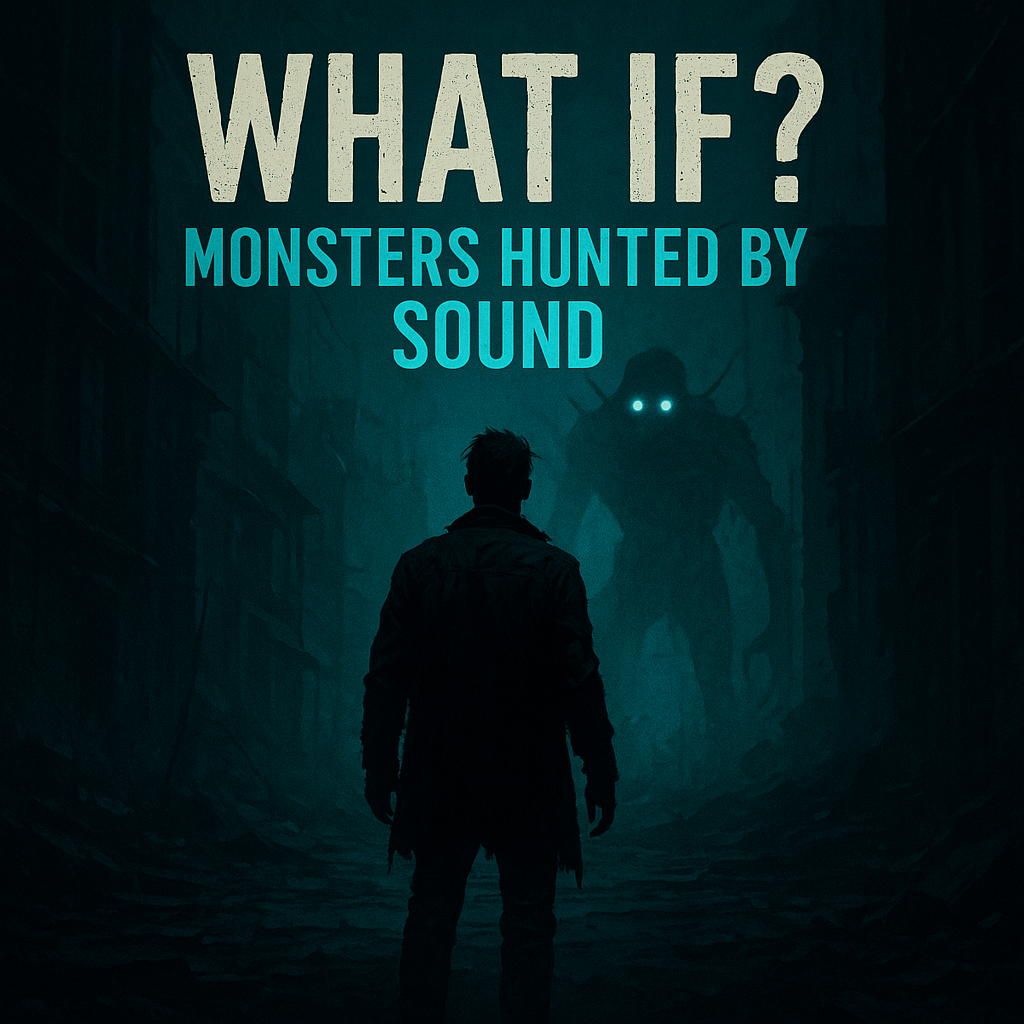
When monsters begin hunting anything that makes a sound, humanity collapses into absolute silence. Noah, a former sound engineer, discovers a young girl who can speak and cry without triggering the creatures. As he protects her, he learns the truth: the monsters aren’t killers—they’re guardians trying to hide humanity from a far greater cosmic entity that hunts silence itself. When the terrifying “Quiet One” descends from the sky, Noah climbs a broadcast tower and unleashes the loudest scream of his life, summoning the monsters to fight it off. The world survives—but only until the next time humanity grows too quiet.
I. The Day the World Went Quiet
It began at 6:12 p.m. Pacific Time, during the final hour of a typical Tuesday rush. In Los Angeles, commuters honked at a stalled truck on the 405. In Tokyo, schoolchildren laughed as they burst from their classrooms. In São Paulo, a street musician struck the first chord of his nightly performance.
All of them vanished in an instant.
One second they were there, wrapped in the noise of everyday life. The next second, shimmering distortions sliced through the air like cracks in invisible glass. The distortions moved impossibly fast—faster than sound itself—leaving nothing behind but stillness.
At 6:13 p.m., every major city on Earth fell silent.
Not because people chose to be quiet.
But because they learned what happened when they weren’t.
Monsters—if that was the right word—had appeared everywhere sound existed. Not with form or shadow or claws, but as violent ruptures in space, like the world itself had learned to attack anything that made a noise.
A cough meant death. A dropped phone meant death. A scream meant death.
People understood the rule within the hour:
Silence is survival.
And the world obeyed.
II. The First Week in Silence
The first week after the Event shattered civilization more easily than any war.
Hospitals became morgues within minutes—alarms, monitors, wheeled beds, shouting. Fire stations burned down as their own sirens summoned death. Airports became graveyards when engines roared.
Governments issued emergency mandates without speaking—broadcasts of scrolling text, silent videos from trembling officials. Entire cities were evacuated through gestures alone.
Tiny mistakes killed thousands.
A mother dropping a metal spoon. A man sneezing. A street vendor knocking over a crate of tomatoes.
Humans learned quickly:
- Conversations became whispers of sign language.
- Doors were padded with cloth.
- Streets were layered with sand to absorb footsteps.
- Old cars with loud engines were abandoned.
- Pets were let loose rather than risk accidental barking.
Even nature adapted.
Birdsong vanished. Crickets fell quiet. Wolves padded silently through forests, confused and terrified.
Humanity had entered the Quiet Age.
Yet not everyone accepted silent survival.
Some wanted to understand the monsters instead of hiding from them.
One of them was Noah Reyes.
III. Noah, Keeper of Echoes
Before the Event, Noah had been a sound engineer—a man who lived for frequencies, mixes, harmonics, the subtle tremble of a violin string.
He lost everything on day one: his studio, his city, his friends, his voice.
But he kept his knowledge.
Noah believed that anything hunting sound must be sound in some way. That the monsters weren’t creatures—but distortions. Resonance anomalies. Aberrations reacting to vibration patterns.
While others hid underground, Noah scavenged old recording gear from abandoned studios. He tested frequencies with tuning forks wrapped in cloth. He watched the distortions appear and vanish through narrow slits in boarded windows.
They didn’t react to all sounds.
Only certain ones.
High frequency. Sharp resonance. Impact vibration.
Like something was listening selectively.
And learning.
Noah’s discovery spread through survivors like a rumor: sound could be weaponized… or shielded.
But no one was willing to test that theory.
Until the night Noah picked up a faint, impossible noise—crying.
IV. The Child Who Should Not Exist
He heard it while scavenging near an abandoned supermarket: a soft, unmistakable whimper echoing through a shattered window.
A child.
A child crying openly.
She should have been dead the moment she sobbed.
Yet she wasn’t.
Noah followed the sound cautiously, heart pounding, every instinct screaming at him to stop. He found her beneath a toppled produce shelf—a tiny girl in a dusty pink jacket, cheeks wet with tears.
“Hey…” Noah whispered—then froze.
Whispering was suicide.
But she didn’t die. No monster came.
The girl looked up at him with wide, tearful eyes. “You’re loud,” she whispered back.
Noah felt the blood drain from his face.
She could speak. She could cry. She could make noise.
And nothing was killing her.
He knelt carefully and gestured in sign language:
How?
She blinked and whispered: “They don’t want to hurt me.”
Noah felt a chill crawl down his spine.
Why?
Before he could gesture again, the air above them warped. A distortion—one of the monsters—descended into the aisle, shimmering like melted glass.
It hovered directly overhead.
The girl didn’t scream.
Noah covered her mouth, trembling violently.
The creature drifted closer… and then, impossibly, backed away.
Retreating.
Avoiding her.
Not hunting her.
He realized then:
The monsters weren’t here to kill the child. They were following her.
But why?
He didn’t know yet.
But he knew one thing:
He had to get her to the Silent Settlement.
V. The Silent Settlement
Hidden beneath an old library, the Silent Settlement was one of the last organized survivor enclaves—thirty people living in padded tunnels, communicating through signs and writing boards.
When Noah arrived carrying the girl, the entire settlement reacted in panic.
A child who cried was a death sentence.
Noah silenced them with frantic gestures and signs:
She can speak. She is immune. The monsters avoid her.
Disbelief turned to horror, then to curiosity.
Mara, the settlement leader, led Noah and the girl into a sealed chamber deep underground.
In the dim torchlight, she signed:
Who is she?
Noah signed back:
I don’t know. But she’s important. They’re drawn to her. Not to kill… to find.
The girl stepped forward and whispered softly:
“They’re scared.”
Mara’s eyes widened.
Scared? Monsters?
Impossible.
But the girl continued, voice trembling:
“They’re not the real danger. They’re just… listening. Hiding.”
“Hiding from what?” Noah mouthed silently.
The girl looked upward, as if hearing something far beyond human perception.
“From the one who made them.”
The chamber fell into suffocating silence—not out of fear of monsters, but of meaning.
Noah signed slowly:
Made them? Who?
The girl’s expression broke into sorrow older than her years.
“I don’t know,” she whispered. “But it’s coming. And it doesn’t hunt sound.”
She looked at Noah.
“It hunts silence.”
VI. Understanding the Monsters
With the girl’s help—and Noah’s sound expertise—the settlement spent weeks studying the creatures.
They discovered horrifying truths:
The monsters appeared only around certain frequencies.
Not all noises summoned them—only sharp, sudden, irregular sounds.
They avoided consistent sound patterns.
Rhythms. Music. Repeating noise.
They vibrated at a frequency only the girl could hear.
She said the vibrations were “voices.” Not angry ones. Fearful ones.
They were not attacking humans.
They were reacting to our noise… Because noise was dangerous.
Noah constructed a primitive spectrogram using scavenged electronics. The monster vibrations formed a pattern—an encoded warning.
He translated what he could: a repeating sequence, a frantic oscillation.
Almost like a message.
When he showed it to the girl, she whispered:
“They’re warning us to stay quiet. Because it’s listening.”
Noah froze.
What was “it”?
The girl trembled.
“It made them as shields. To stop humans from making noise. To keep the world silent. Because silence keeps us hidden from something else.”
Mara signed urgently:
Something else? Where?
The girl pointed upward.
“The sky.”
VII. The Hum Above the Clouds
A month after Noah found the girl, the settlement heard it.
Low. Vast. Inescapable.
A deep humming vibration drifting down from the upper atmosphere—felt in bones, not ears. It pulsed like a heartbeat too slow to belong to anything living.
The monsters reacted instantly.
They swarmed upward in spiraling distortions, abandoning the ground entirely, racing toward the sky as if answering a summons—or fleeing something.
The girl began crying again—not in fear, but in heartbreak.
“They can’t stop it,” she whispered. “They were only trying to hide us. To keep us quiet. So it wouldn’t hear us.”
Noah swallowed hard.
“What is coming?”
Her answer chilled him more than any monster ever did.
“The quiet one.”
VIII. The Thing That Hunts Silence
The humming grew louder over the next hours.
Birds fled oceans. Clouds twisted unnaturally. Shadows darkened even at noon.
Noah and the settlement climbed to the surface as the ground vibrated beneath them. The monsters above swirled chaotically, forming a shimmering barrier that stretched from horizon to horizon.
Then the sky rippled.
Something enormous—larger than storms, larger than mountains—moved behind the clouds, warping the atmosphere as if reality itself were fabric being pushed from the other side.
When the clouds split, they revealed darkness.
Not space. Not night.
A shape so perfectly silent that it erased sound around it.
No wind. No breath. No heartbeat.
Silence incarnate.
The girl clutched Noah’s hand.
“It came because we were too quiet for too long,” she whispered. “The monsters wanted us loud so it couldn’t find us. But we hid. And now it knows we’re here.”
The living distortion above the clouds unfurled slowly, impossibly, like a massive, starless maw opening toward Earth.
Noah felt every instinct scream.
The monsters hunted sound. But this thing hunted its absence.
The girl looked up at Noah with sorrow too deep for her age.
“They were trying to protect us,” she whispered. “But we silenced ourselves too well.”
She squeezed his hand.
“You have to be loud now.”
Noah stared at her.
Loud?
Now?
With the sound-hunting monsters gone… there was no one left to stop the Quiet One.
Except…
Noah understood.
He had spent his life shaping sound. He knew how to make noise big enough to shake the sky.
He turned to the settlement.
To Mara.
To the terrified survivors.
And in absolute silence, he nodded.
It was time to break the Quiet Age.
IX. The Last Noise on Earth
Noah climbed the old skyscraper—the tallest one still standing. The girl followed. The sky pulsed with the approaching Quiet One.
On the roof sat the last working thing Noah had ever built:
A battered but functional broadcast tower.
He pressed his hand to the rusty controls.
He inhaled deeply.
And for the first time in two years…
He screamed.
A raw, primal, furious scream—the roar of a man who had lost the world and found one final purpose.
His scream echoed through the tower. Amplified. Broadcast.
A volcanic eruption of sound ripped across the city, then across the region, then across the entire broken Earth.
The air distorted.
Reality vibrated.
And the monsters returned.
Every single one.
Thousands of distortions shrieked downward from the sky, drawn by the noise—but not to kill.
To fight.
They hurled themselves upward, forming a living barrier of vibrating space between Noah’s scream and the descending Quiet One.
Noah didn’t stop screaming.
Not when blood filled his throat. Not when his voice tore. Not when his knees buckled.
He screamed until the sky flashed white.
X. What Remains After Silence Breaks
When Noah awoke, the girl was beside him.
The sky was clear. The monsters were gone. The Quiet One had retreated.
The world was safe— for now.
She touched his hand gently.
“They heard you,” she whispered. “And they’ll remember.”
Noah coughed weakly.
“Will it come back?”
She nodded.
“Someday. When we’re too quiet again.”
He looked at her, exhausted.
“What do we do until then?”
She smiled softly.
“We live. Loud enough to stay human. Quiet enough to stay alive.”
And together, they descended the tower— into a world learning, once again, how to make noise.