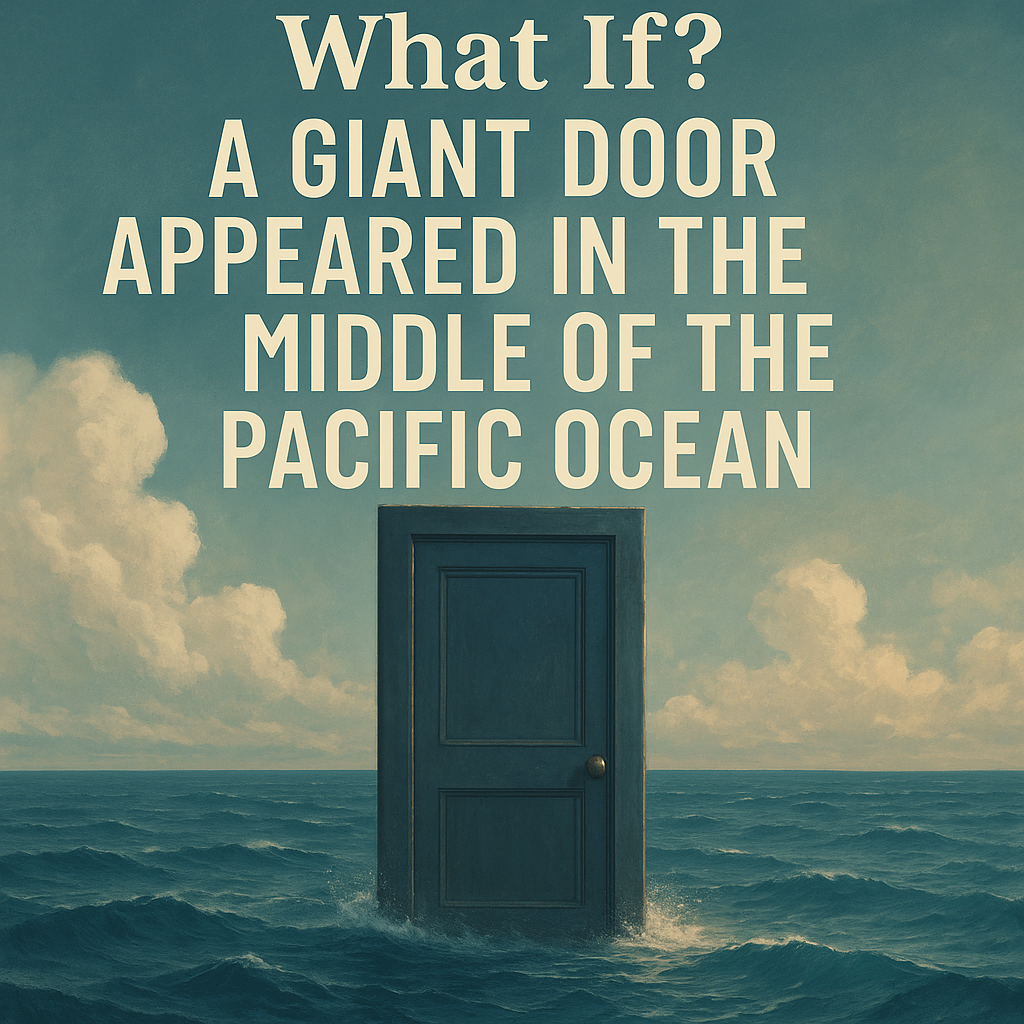
When a colossal, physics-defying door appears in the middle of the Pacific Ocean, humanity descends into awe, panic, and prophecy as the structure begins communicating through dreams and visible-only-to-humans cracks of glowing blue light. Animals swarm toward the site. Clocks reset worldwide. And a young girl named Emily—mysteriously able to read the ancient symbols on the door—reveals the truth: the door is a cosmic checkpoint left by an ancient civilization that once nurtured early life on Earth. As the door psychically asks all of humanity the same question—“Do you wish to continue?”—the world undergoes a silent global vote. When the answer resonates through the structure, the door gently sinks back into the ocean, leaving behind a single glowing seed in the deep as a silent promise that it will return when humanity is ready for its next step.
I. The Door That Should Not Exist
It appeared just before dawn—the moment the Pacific shifted from ink-black to bruised lavender—rising from the water as silently as the turning of a page. No tremor shook the sea. No wave swelled around it. No plume of displaced water rose in protest. One second the ocean was empty, and the next a structure the height of a skyscraper stood upright, perfectly vertical, embedded in nothing, floating in nothing, held by nothing.
A door.
Rectangular. Seamless. Featureless. Three hundred meters tall. Forty meters wide. Made of a material no satellite could categorize, its surface a shifting metallic stone that reflected no sunlight and cast no shadow.
The first fishing boats that approached found their engines dying the moment they crossed a one-kilometer radius. Compasses spun. Sonar returned impossible readings—depths that suggested a hole straight through the Earth. Radios emitted a faint knocking sound, continuous and rhythmic, like someone tapping gently on the other side.
By dawn, every major news network in the world had switched to the same feed: a live shot of the Pacific, and the impossible door rising from it.
The world did not scream. It held its breath.
Because somewhere deep inside—even if they did not yet understand what they were looking at—humans recognized what it meant for a door to appear where no wall existed.
Something wanted to come in. Or wanted us to step out.
II. The Door Begins to Wake
The object resisted every attempt at analysis. Lasers sent to measure its depth simply vanished. Metal samples melted into its surface like sugar dropped onto a hot pan. Even light seemed reluctant to touch it, bending slightly around its edges as if respecting a boundary.
Animals reacted first.
Birds migrating across the Pacific suddenly diverted their routes, flying perfectly straight toward the door until military jets forced them away. Dolphins circled the perimeter at night, singing the same tonal phrase, soft and haunting. Whales gathered in massive clusters beneath the surface, releasing low-frequency moans that trembled ships miles away.
The animals, it seemed, recognized something we did not.
And then the dreams began.
All around the world—different languages, different cultures, different ages—people dreamt of the same thing: a massive door standing in a dark ocean, and a soft knocking from the other side.
Three knocks. Pause. Three knocks. Pause. Three knocks.
A heartbeat. A request. A rhythm older than civilization.
Some awoke sobbing. Some awoke praying. Some awoke smiling with inexplicable calm.
But all awoke knowing one thing:
The door was not waiting. It was listening.
III. The Cult of the Doorkeepers
Within a week, the world split into factions. Scientists wanted to understand it. Governments wanted to weaponize it. Religious leaders wanted to sanctify it. The general public wanted to survive it.
And then there were the Doorkeepers— a rapidly growing global movement claiming the door was a sign of humanity’s “graduation,” the moment Earth would meet its creator, its future, or both. They preached unity, pilgrimage, and unconditional acceptance. Their symbol, a simple outline of a tall rectangle, flooded social networks, flags, and homemade tattoos.
Their mantra:
“The door appears when the world is ready.”
Opposing them were the Wardens, who insisted the door must remain closed at all costs. Something sealed behind such a lock, they argued, was sealed for a reason. They cited old myths—boxes that should not be opened, seals that kept chaos at bay, prisons mistaken for gifts.
Their slogan was simpler:
“Some doors are closed for our protection.”
And meanwhile, the door itself remained quiet, unchanging, unyielding.
Until the first crack appeared.
IV. Blue Fire in the Cracks
The event happened at night. Satellite imagery showed a sudden spike of ultraviolet radiation around the door—like a star being born underwater. The surface of the door vibrated, and thin lines of blue light traced themselves across its edges, as though veins within it had begun to glow.
Every ship within five kilometers lost power. Every compass on Earth flickered. Every digital clock reset to 00:00.
The crack was no larger than a human finger, but it emitted a sound—an impossibly low hum that every human on Earth felt rather than heard. Some collapsed. Some clutched their heads. Some cried without knowing why.
And then, the world noticed something even stranger:
The crack did not appear on any camera footage. Not on satellites. Not on drones. Not on military surveillance.
It existed only to the naked human eye.
The door was communicating directly with consciousness.
V. Emily
The breakthrough came from an unexpected place: a seven-year-old girl named Emily Vargas from a small coastal town in Chile.
Emily had been drawing pictures of the door for days—drawings containing details no one could see, including complex symbols etched across the top of the structure. When linguists analyzed her sketches, they found matches with prehistoric carvings found in caves across the globe—carvings so old that no known civilization should have been able to coordinate them.
Emily was brought to a secure research facility. She was shy, gentle, soft-spoken.
When asked how she knew what the symbols meant, she replied:
“They show me.”
“The door?” the lead scientist asked.
She shook her head.
“No. The ones behind it.”
And then she added:
“They’re waking up.”
VI. The First Opening
At precisely 3:03 a.m., seismographs all over Earth registered a tremor—one not originating from below the ground, but from the ocean surface itself. Satellites captured a flash of light brighter than lightning. A wall of mist rose around the door.
The door swung open.
But not physically—ships saw nothing. And yet, around the world, people watching live broadcasts gasped in horror or awe as an enormous, blinding void appeared behind the door, visible only to the human mind.
The sensation was universal: a pull toward the void, a feeling of being recognized, evaluated, measured.
A whisper filled the world:
“Invitation pending.”
VII. The Message
Emily was the first to decipher the symbols. They formed a sentence:
“The cradle opens when the child is ready.”
Scientists debated what that meant. Religious scholars declared it was divine. Philosophers claimed it was a metaphor for evolution.
But Emily clarified:
“They don’t mean a baby. They mean humanity. They left us here to grow.”
The researchers stared, breathless.
“Left us?”
Emily nodded.
“They used to live here. Long before us. Before anything walked. Before anything breathed. This world was theirs. They grew us. And they left the door so we could choose, one day, to join them.”
“Join them where?”
She pointed at the glowing crack.
“Outside.”
VIII. The Choice
More cracks formed, each brighter than the last. The ocean boiled around the door without heat. Clouds formed geometric spirals above it. Animals began migrating toward the Pacific from every direction on Earth, driven by an instinct older than the species themselves.
And then the final message appeared—visible to every human mind, projected by the door itself:
“Do you wish to continue?”
Not continue life. Not continue evolution. Not continue civilization.
Continue as we are.
It was a test. A cosmic check-in. A moment of reckoning.
Do we choose to ascend? Transform? Disappear? Or remain as humans—imperfect, violent, hopeful, chaotic, miraculous humans?
The vote was not political. It was psychic.
Every human felt the question in their bones.
Emily stood at the shoreline, staring at the door through tears.
“They won’t force us,” she whispered. “They promised.”
The world answered.
The response was not unanimous. But it was enough.
The final message appeared:
“CONTINUE.”
IX. The Parting Gift
The cracks sealed. The glow faded. The ocean calmed.
The door, impossibly, began to sink—slowly, gently—descending into the Pacific until its last visible edge disappeared beneath the waves.
But just before it vanished entirely, one final ripple of light passed across its surface, and a new symbol appeared for a moment—one Emily gasped to see.
“What does it mean?” a researcher asked.
Emily smiled through tears.
“It means they’re proud of us.”
And then the door was gone.
No quake. No explosion. No trace in sonar. Just open water, as though it had never been there.
Almost.
Because satellites detected something new at the bottom of the ocean—a glowing object, slowly drifting downward, sinking deeper and deeper, as if making room for humanity to grow.
A seed.
A reminder.
A promise.
The door will open again when we are ready.