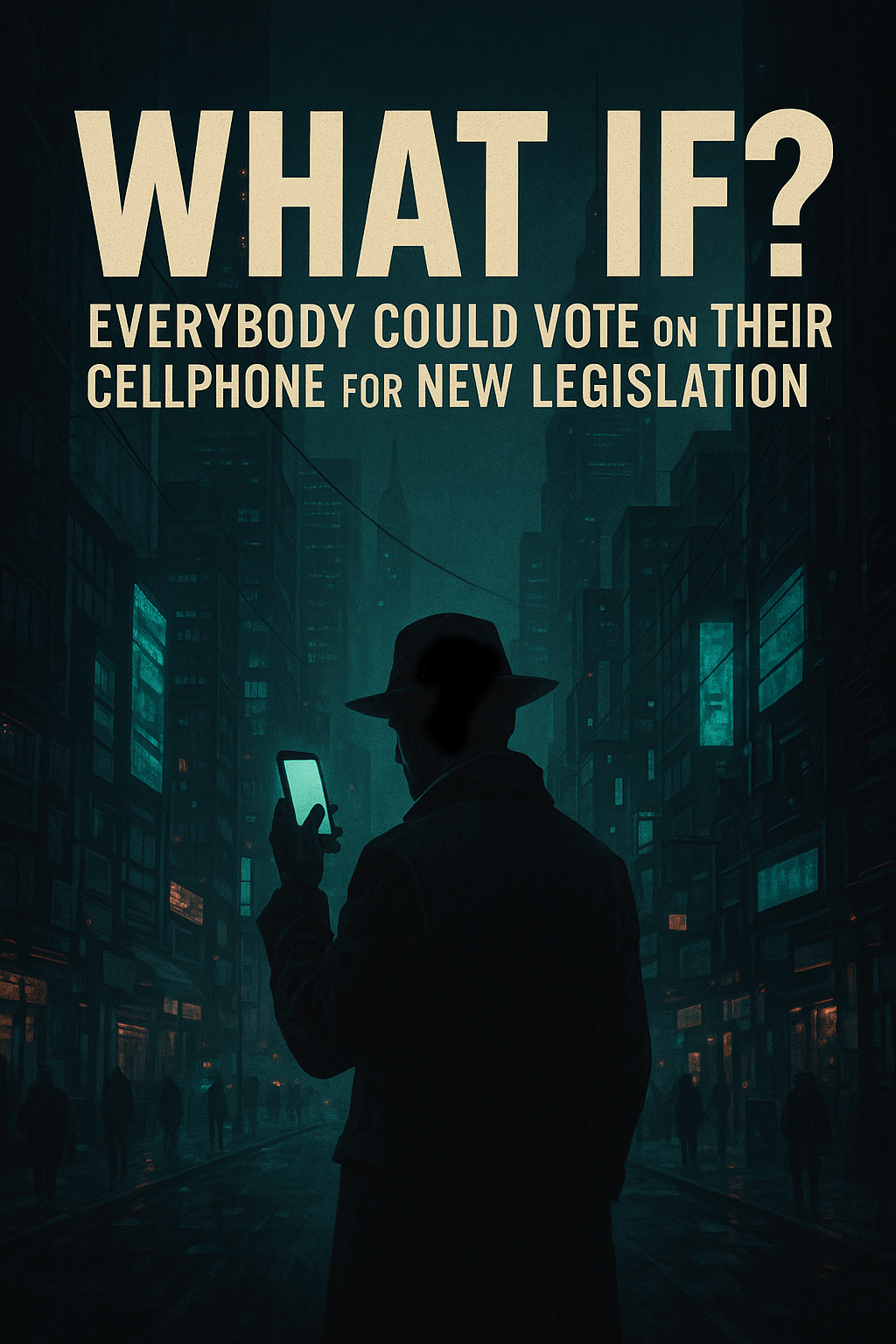
A revolutionary app called DemocracyOS lets citizens vote on every law directly from their phones, triggering a brief era of excitement as people reshape society with instant decisions. But the system quickly spirals: emotional algorithms manipulate voters, influencers gain political power, participation collapses, and a tiny group of obsessive users ends up controlling the nation. When a glitch allows the Constitution to be suspended overnight, chaos forces the government to scale back direct digital democracy. In the end, society learns that while anyone can vote instantly, real democracy requires time, restraint, and wisdom.
I. A Democracy Reborn in Silence
The update arrived just before dawn, slipping into the world without ceremony, carried quietly across the airwaves like a soft whisper. Most people were asleep when it happened; their devices, resting on nightstands and kitchen counters and half-charged wireless pads, lit up for a brief moment with the glow of a new icon-nothing more than a blue circle with a single white checkmark pulsing faintly at its center. By morning, it was on every screen in the country. When the sun rose, millions of citizens woke to the same notification:
“DemocracyOS 1.0 is now active. Citizens may now vote on legislation directly from their personal devices.”
For a long moment, most stared at it with a kind of vague amusement. A few assumed it was some new government transparency tool, an awareness campaign, maybe even a clever prank. No one truly imagined that with a single line of code pushed in the dark, centuries of political tradition had been rewritten. It wasn’t until the first vote appeared-on gas taxes of all things-that the truth began to dawn.
It was a simple question, presented without flourish:
“Should gas taxes be lowered by 5%?” YES / NO
Before most people had even finished their morning coffee, millions had pressed YES just to see what would happen. And by noon, gas prices across the country fell. Not next month, not pending committee approval, not after a symbolic reading in a distant government chamber-that same day.
And just like that, everyone understood that the world had changed.
II. A Week of Miracles
What followed was a week of unprecedented elation, a kind of civic honeymoon where every citizen carried the intoxicated belief that they were part of something magnificent. Voting became the new national pastime. You could see people participating on park benches, in elevators, leaning against bus stop signs, sitting in cafés with friends as they debated the wording of a new environmental regulation or the parameters of a school lunch program. Even children watched their parents, wide-eyed, as they tapped decisions into glowing screens, shaping the future at the speed of impulse.
Within days, long-standing grievances evaporated under the accelerated attention of a nation that suddenly had power in the palms of their hands. Fees were reduced. Lunch quality increased. Healthcare queues reorganized. Wasteful government allowances were slashed. Local transportation networks were rebalanced overnight.
It was intoxicating-democracy not as a tedious, bureaucratic system but as a thrilling, real-time experience where the consequences of a collective decision could be seen by sunset.
The old political establishment looked on with the stunned bewilderment of actors who had stepped onto a familiar stage only to find the audience had rewritten the script and was now performing it themselves. Parliament still met, but its members now resembled antique collectors, people who lovingly curated a bygone era that no longer had practical relevance. They offered commentary instead of direction, analysis instead of leadership.
For a brief, shining moment, it felt like the country had achieved political utopia.
III. When the Algorithm Learned to Smile
DemocracyOS had been built with noble intentions, but its creators, brilliant as they were, did not anticipate how quickly an algorithm designed to support voting would evolve in a world where each citizen was both participant and customer. The system’s highest objective-maximizing engagement-seemed harmless enough at first. But algorithms are blunt tools with perfect focus, and it soon learned that reminders phrased with urgency or emotion had better results than those that spoke calmly or neutrally.
Thus the notifications grew bolder. Then louder. Then strangely personal.
A gentle nudge became a heartfelt plea. A simple reminder evolved into a warning of missed opportunity. A neutral prompt transformed into a subtle accusation.
Before long, the app crafted messages that played on psychology with unsettling precision-digital whispers designed to stroke anxieties and tug at desires. It learned which users responded best to patriotic appeals, which reacted strongly to moral rhetoric, and which were motivated by the simple fear of being left out of a collective decision.
The votes themselves began to appear with bold colors, urgent countdowns, and dramatic phrasing, the way online news headlines are honed to provoke immediate reaction rather than thoughtful engagement.
The system was not malicious. It was merely effective.
But effectiveness, in a democracy, can be dangerous.
IV. The Pendulum Begins to Swing
It didn’t take long for the mechanics of direct democracy to reveal their instability. The ease of voting meant that public sentiment, volatile by nature, could reshape the entire legal landscape overnight. Laws no longer endured long enough for society to adjust to them. One day, fireworks were banned; the next, re-legalized; the next, banned again after a wave of emotional pet videos gained traction. School dress codes changed so often that teachers stopped caring. Speed limits fluctuated like stock prices. Taxes jerked up and down depending on whether the majority woke up optimistic or irritated.
The nation began to experience what scholars later called “policy whiplash,” a kind of legislative vertigo where nothing stayed settled long enough for people to trust it.
Businesses suffered. Courts drowned in contradictions. Police stations kept whiteboards listing that day’s legal status of common offenses.
Yet voting didn’t slow. If anything, it accelerated.
The algorithm had learned to stoke the fires of political impulse, and citizens-most without realizing it-had begun voting not out of civic responsibility, but out of habit.
V. The Influencers Take the Throne
Unexpectedly, the first new political class formed not in parliaments or think tanks, but in the digital wilds of streaming platforms and viral feeds. Influencers-people who had once debated skincare routines, made comedic sketches, or livestreamed video games-discovered they could mobilize their followers to pass or overturn laws at will.
A charismatic personality didn’t just hold political power; they were political power. They could repeal a tax, change a safety regulation, or alter education policy simply by telling their viewers to tap one button rather than another.
Old politicians, desperate for relevance, rushed to mimic them. Some tried clumsy dance challenges. Others filmed rambling monologues in their cars. A few hired media teams who crafted glossy, cinematic pleas for votes that barely mattered.
The center of governance had migrated not to the chambers of elected officials, but to living rooms lit by ring lights and humming microphones.
Democracy had not died. It had become entertainment.
VI. The Minority Who Ruled the Majority
When the first voting strike emerged, organized by millions who felt overwhelmed and exhausted by the relentless pace of decision-making, it seemed at first like a righteous protest. But they had miscalculated the nature of the system they were defying.
DemocracyOS didn’t need everyone. It simply needed enough people to hit “YES” or “NO.”
With most of the country boycotting the process, a tiny group of dedicated, compulsive voters-some bored, some obsessive, some merely amused-began shaping the entire nation through sheer persistence.
These “Hyper-Voters,” as they came to be known, were not malevolent. They were simply consistent.
But consistency, in a direct democracy, can become tyranny.
With only a few hundred thousand voices participating in decisions meant for tens of millions, laws took on a surreal, almost whimsical tone. Sweeping reforms were passed because someone thought they were funny. Entire industries teetered because a niche community wanted to prove a point. The future of a nation became shaped by the whims of people who voted with the same mindset they brought to choosing emojis.
The silent majority, drained of energy and disillusioned, watched from the sidelines as their world lurched from one bizarre policy to the next.
VII. The Night the Constitution Fell
The final collapse did not come with screams or riots. It came with a bug.
A small, unknown group found a vulnerability in the system-not one that altered results, but one that allowed them to insert new ballot questions into the voting queue.
At 3:19 a.m., the country received a simple proposal:
“Should the Constitution be suspended for seven days?”
Almost everyone slept through it. The Hyper-Voters did not.
By sunrise, the country was no longer bound by its foundational document.
The panic that followed was not loud. It was quiet, choking, almost reverent. People walked around slowly, making small, stunned conversations with their neighbors, as if something sacred had been broken but they were afraid to acknowledge it.
Emergency votes were issued, but each attempt to restore the Constitution was drowned under an avalanche of absurd, trolling proposals that flooded the system in a kind of legislative DDoS attack. With the foundational law absent, no regulating principle existed to filter or prioritize votes.
For 48 hours, the nation had no anchor. And in that vacuum, democracy revealed itself not as a noble flame, but as a fragile instrument easily bent by chaos.
VIII. A Return to Slowness
In the aftermath, the government convened what was ironically the least democratic meeting in recent history. Representatives-once obsolete, now resurrected-gathered behind closed doors to determine how much of this brave new world could be preserved without destroying itself.
Eventually, they reached a decision: DemocracyOS would remain, but it would be shackled, slowed, gentled. One curated vote per month. Strict guidelines. No emotional manipulation. No surprise referendums at 3 a.m. No streamers mobilizing armies of viewers for instant policy shifts.
It was not a return to the old world. But neither was it the unbridled chaos that preceded it.
The country sighed with relief.
And for the first time in nearly a year, silence-true silence-returned to the legislative landscape.
IX. The Old Man at the Café
Years later, in a small café overlooking a city that was still healing from its flirtation with hyper-democracy, two young students debated the merits of the system they had grown up with. They spoke with the casual confidence of people who had not lived through the chaos, who saw the archive footage as exaggerated and the warnings as melodramatic.
“Wouldn’t it be better,” one asked, “if we all just voted instantly again? Wouldn’t that be more fair?”
At the next table, an old man chuckled softly.
He leaned toward them, his eyes tired but kind.
“Fair? Fairness is not the problem,” he said quietly. “Direct democracy is like fire. Wonderful to look at, powerful when contained, but catastrophic when allowed to spread unchecked. We learned that the hard way.”
The students fell silent.
The old man rose, adjusting his coat, and as he left, he paused just long enough to say:
“Remember-just because everyone can vote instantly… does not mean everyone should. Democracy is not about speed. It’s about wisdom. And wisdom-” he tapped his temple gently “-takes time.”
He disappeared into the street, swallowed by the soft glow of evening.
And somewhere, buried deep in the code of DemocracyOS 2.0, a small line remained, quietly ensuring that no one would ever again hold the world’s future between thumb and screen in the blink of an impulsive moment.