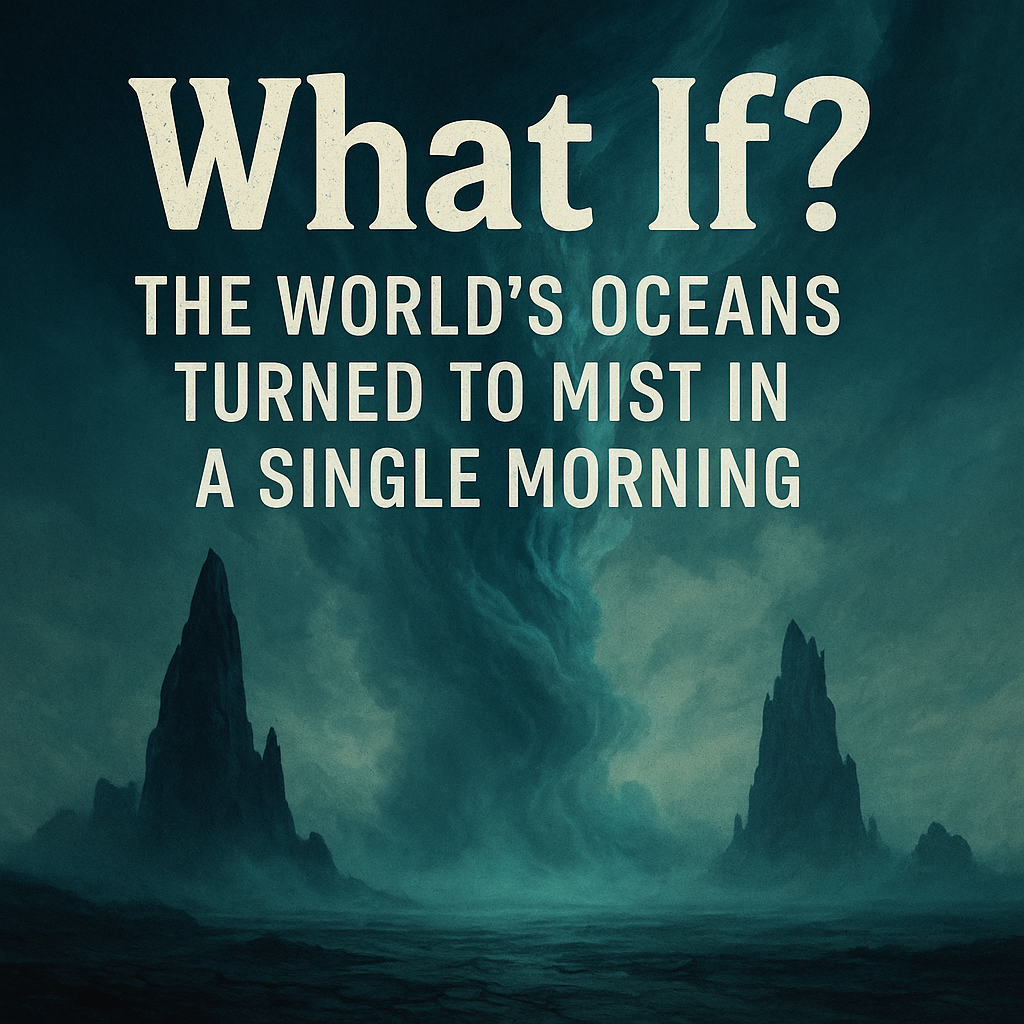
At dawn, every ocean on Earth abruptly rises into the sky as shimmering mist, leaving behind empty basins and global chaos. The mist behaves like a living intelligence, forming patterns identical to ancient symbols carved into the newly exposed seafloor. Deep-sea creatures emerge and survive on land, seismic sensors detect continent-sized pulses resembling whale songs, and enormous spirals of mist gather above tectonic fault lines. A child who “hears the mist talking” reveals the oceans were never natural—they were a cradle for something older than life on Earth.
As colossal geometric structures descend from space and lock into empty ocean basins, a titanic Leviathan rises from the Mariana Trench, merging with the mist and proclaiming that the “Dry Ones” were only temporary guests. The oceans refill with glowing alien fluid as a final message echoes across the world:
“The cradle is restored. The hosts have returned.”
I. The Morning the Oceans Vanished
It began at 6:12 a.m. local time across every major coastline on Earth, though the phenomenon’s synchronicity wouldn’t be understood until much later. For the people living along beaches, boardwalks, shipping ports, and cliffside towns, the first sign was the sound—not a roar, not a crash, but a low, continuous hiss like a giant exhaling in frustration. At first, most assumed it was fog rolling in, or perhaps a strange temperature inversion, but then the horizon began to fold upward in shimmering curtains of silver vapor, rising in sheets as smooth as glass. Within minutes, entire oceans began lifting into the sky in vast, vertical cascades of mist, rising not outward or sideways but straight up, defying wind currents, atmospheric gradients, and every law known to meteorology.
Fishing boats that had bobbed comfortably moments earlier suddenly thudded onto dry seabed. Cargo ships keeled sideways, their hulls cracking as they slumped into mud. Tourists screamed as dolphins, whales, and schools of fish writhed in the drying surf. But the most shocking part was not the disappearance of the water—it was the precision. The evaporation line advanced with mathematical perfection, as if an invisible wall were moving across the ocean’s surface, lifting water in a uniform vertical plane and leaving behind only exposed salt flats, rocky shelves, and the mangled remains of coral.
By the time coastal authorities issued emergency alerts, every ocean basin on Earth had begun its ascent into the air.
And the water wasn’t falling back down.
Not as rain, not as humidity, not even as clouds.
It was simply rising, gathering, vanishing into a silent layer high in the atmosphere that no satellite could penetrate.
The hydrologic cycle had been switched off.
Earth was drying at the speed of catastrophe.
II. The Salt Flats and the Things Beneath
Within hours, former coastlines devolved into apocalyptic chaos. Seaports became graveyards of vessels. Marine wildlife died by the millions. Cities built around water transport—Singapore, San Francisco, Sydney, Rio—lost their entire economies before lunchtime. The United Nations declared a planetary emergency before noon.
But that wasn’t the worst of it.
By midday, seismographs worldwide detected strange vibrations emanating from the newly exposed seabeds. Not earthquakes—rhythmic pulses, spaced evenly apart like a heartbeat amplified through stone.
The deep trenches—Mariana, Tonga, Sunda—began to glow faintly, their surfaces etched with luminous lines that had never been seen when they were submerged. Marine biologists, geologists, and oceanographers dispatched to these areas reported seeing shapes rising from the depths: creatures that should never have survived without water, yet moved with eerie confidence across the desiccated ocean floor.
One research drone captured footage that broadcast only once before being scrubbed from the internet: enormous cephalopod-like organisms slithering across the dry seafloor, their bodies supported by reinforced cartilage structures that had clearly evolved for both deep pressure and surface locomotion. Another clip showed pale, translucent fish ascending into the air as if still “swimming,” suspended by pockets of denser mist that clung to them like invisible water.
But the most unsettling discovery came from the mid-Atlantic ridge.
Carved into exposed bedrock, kilometers wide, were symbols—spirals, triangles, and fractal patterns—that matched markings found on megalithic ruins across five continents.
The ocean floor held a message.
A message older than any civilization.
III. The Mist That Didn’t Behave
As satellites attempted to track the rising fog, meteorologists noticed a disturbing phenomenon: the mist was not behaving like vapor. It ignored wind entirely. It moved in coordinated flows, gathering into massive clusters that drifted toward convergence points above ancient tectonic boundaries.
It seemed to be thinking.
Atmospheric probes recorded faint electrical pulses within the mist, resembling rudimentary neural activity. When charged with bursts of energy, the mist morphed into complex shapes—branching fractals identical to coral, radiating patterns like starfish, spirals reminiscent of ammonites.
It was as if the ocean’s entire evolutionary memory were replaying in minutes.
A lab in Sweden confirmed the unthinkable: the mist contained microscopic structures—liquid crystals aligning themselves into self-organized patterns.
The mist was alive.
Or at least, becoming alive.
And it was learning.
IV. The Leviathan Pulse
The first global blackout of seismic sensors occurred around 3:40 p.m. UTC. Every deep-earth monitoring station went dark simultaneously, as if an electromagnetic pulse surged upward from beneath the crust. When power returned, the machines recorded something impossible.
A pulse. A rhythmic, rising call. Matching the structure of whale songs.
But magnitudes larger.
A being the size of a continent was signaling.
Hydrophones—desperate to detect anything—picked up faint echoes across dry ocean basins. The signal repeated at perfect intervals.
Boom. Boom. Boom.
Not random noise.
A call-and-response pattern.
The mist responded by forming spiraling vortices in the sky.
Nature was not collapsing.
It was awakening.
V. The Boy and the Circles
Late that afternoon, a nine-year-old boy named Yori Tanaka wandered onto the exposed coast near Sendai. While tourists and locals panicked around him, he stood perfectly still, staring at the drifting mist overhead. When asked what he was doing, the boy replied without hesitation:
“Listening.”
His mother tried to pull him away, but he resisted with surprising strength.
“It’s not dangerous,” he said. “They’re talking. They’ve been talking to me for a long time.”
“Who?”
“The ones who made the oceans.”
Yori then walked onto the dry seafloor and began drawing spirals in the cracked mud—complex, nested designs that perfectly matched the ancient inscriptions revealed earlier that day.
Scientists arrived and interrogated him gently. How did he know these patterns?
“They’re waking up,” Yori said calmly. “The oceans were sleeping. The mist is their breath. And the big one is coming.”
“The big one?”
“The parent.”
VI. The Great Cradle
Satellite imagery at sunset revealed something utterly impossible. Above each major ocean basin, the mist had gathered into enormous rotating funnels—towering spirals reaching tens of kilometers high, spinning faster and faster until they punched holes in the upper atmosphere.
These funnels formed a global web of luminous channels that connected to something descending from orbit.
The first object appeared over the Pacific Basin: a massive geometric structure, hexagonal and metallic, glowing with luminescent blue liquid flowing through latticework veins. It was accompanied by dozens of smaller constructs, descending like satellites slotting into prebuilt receptacles.
More structures appeared over the Atlantic, Indian, and Arctic basins.
Each lowered into place with surgical precision, like pieces returning to a machine that had been missing its components for billions of years.
The message was clear.
The oceans had been part of a system.
A containment field. A nutrient bath. A cradle.
And now the cradle was being reclaimed.
VII. The Mist Speaks
At 10:33 p.m. UTC, the mist condensed into a sphere above the former Mariana Trench. The sphere pulsed, flickered, then released a cascading wave of light that spread across the sky.
In every language on Earth, the message echoed:
“THE SEED HAS MATURED. THE CRADLE WILL BE RESTORED. YIELD.”
Billions fell to their knees. Some screamed. Some prayed. Some stared in mute horror at the sky.
Yori simply nodded.
“We were never alone,” he said quietly. “We were guests.” “And the ocean was the nursery.”
VIII. The Awakening Beneath
As the sky blazed with descending structures, the exposed ocean floor began to crack open. Massive fissures spread outward from trenches, ridges, and ancient fault lines. From within, a soft blue glow illuminated the world’s darkest places.
The Leviathan pulse grew louder, faster, more urgent.
When the first colossal shape rose from the Mariana Pit, people around the world felt it in their bones.
A titanic creature—skeletal yet fluid, composed of bioluminescent cartilage, sinuous tendrils, and ancient, crusted armor—emerged from beneath Earth’s crust. It was not a whale, not a squid, not any life form ever cataloged.
It was something older than evolution.
Something that had grown in the ocean’s cradle for eons.
The mist spiraled toward it, merging with its form.
The creature inhaled the world’s oceans as mist into its vast, glowing lungs.
Then it exhaled a single sentence:
“THE TIME OF THE DRY ONES HAS CONCLUDED.”
IX. The Return
One by one, the massive geometric constructs anchored themselves into Earth’s empty ocean basins. They descended deep into the crust, locking into place with thunderous reverberations that shook continents. Pillars of energy rose from each structure, connecting into a planetary grid.
The glow intensified.
The Leviathan and its brethren gathered above their corresponding basins.
A slow, planetary hum filled the air.
The ocean basins were being prepared to refill—but not with Earth’s water.
With something else.
Something thicker. Something luminous. Something alive.
Yori turned to the scientists beside him.
“They’re not replacing the oceans,” he said. “They’re rebooting them.” “We were never meant to inherit this world. We’ve just been using it while they slept.”
The sky tore open as vast reservoirs of alien fluid descended.
The new oceans poured in.
They glowed.
They pulsed.
And they began to spread.
X. The Final Message
As the glowing oceans refilled the basins, drowning coastlines anew, the voice echoed one last time across the world:
“THE CRADLE IS RESTORED. THE HOSTS HAVE RETURNED. THE AGE OF DRY LIFE IS ENDED.”
Humanity’s reign had been nothing more than a temporary anomaly—an intermission between epochs of beings far older, far greater, and far less interested in sharing their planet.
The oceans had never belonged to us.
They had been sleeping.
Now they were awake.
And they had come home.