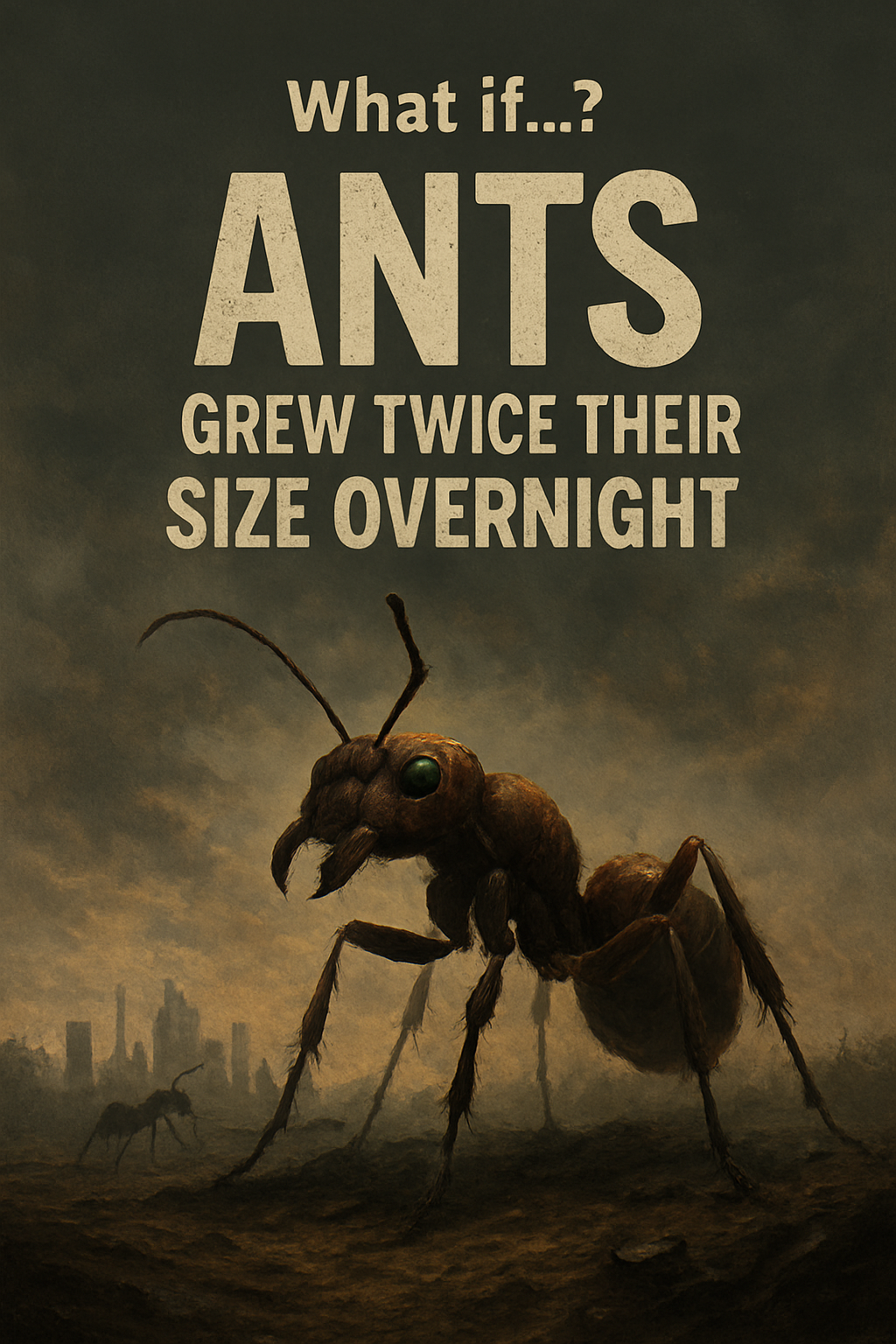
When ants suddenly double in size overnight, a small percentage adapt and rise as Earth’s new apex predators, collapsing ecosystems and threatening humanity.
Introduction
No one remembers which ant was the first to change-whether it happened in the forests of Borneo or beneath a sidewalk in São Paulo. But everyone remembers the first sign: the ground breathed.
It was June 12th. A Tuesday. Humid, quiet, forgettable-right until it wasn’t.
Across the world, from deserts to kitchen tiles, a faint tremor rolled under people’s feet. It didn’t feel mechanical or seismic. It felt organic. Rhythmic. As though something beneath the soil had taken a long, shuddering breath.
And then exhaled.
Most dismissed it. Others blamed construction, traffic, even indigestion. No one imagined that deep in millions of nests, every ant-from leafcutter to carpenter, fire ant to soldier-was undergoing a transformation that defied physics.
Something had rewritten them. No one knew how.
But by morning, ants everywhere were twice their size.
By evening, billions of them were dead.
I. The Day of Dying
Ants were never meant to be that big. Their entire biology depended on tiny proportions. Their spiracles-minute breathing holes lining their bodies-relied on passive oxygen diffusion. Doubling in size meant quadrupling mass but only slightly increasing the openings that fed them air.
Within hours, sidewalks were littered with curled, twitching bodies the size of thumbnails. Lawns were sprinkled with carcasses like black pepper. Entire colonies collapsed as workers suffocated mid-stride, unable to draw enough oxygen to fuel their bloated muscles.
The news called it The Great Ant Die-Off. Scientists predicted global extinction within days. People shrugged.
Humanity was used to bad news. Rising seas. Economic collapse. Food scarcity. Ants dying felt small by comparison-a curiosity, a nuisance, a meme.
No one understood that this was only the first breath of something new.
II. The Survivors
By Day Three, the dying stopped-not because the crisis was over, but because the ones destined to die already had.
The remaining ants-perhaps one in ten thousand-behaved differently.
They dug deeper tunnels, carving new chambers shaped like strange fluted sacs. Colonies pulsed with a low clicking rhythm, like tiny hearts beating underground. Scientists sent micro-drones into the nests, but the drones returned only dust, heat, and a low-frequency tremor they couldn’t explain.
What the scientists didn’t realize, until much later, was that these survivors weren’t just living.
They were adapting.
Slowly at first. Subtly.
Their exoskeletons darkened, absorbing heat and venting it through widening spiracles. Their thoraxes swelled as though something inside was pumping-forcing air down branching tracheal tubes that hadn’t existed the day before.
They weren’t relying on passive air diffusion anymore.
They were evolving a primitive kind of active breathing.
Ants were learning to breathe like tiny mammals.
Their mandibles thickened. Their movements slowed but grew more deliberate. They carried pebbles the size of grapes with effortless precision.
People noticed only when videos began circulating:
“Giant ant dragging a mouse across driveway!” “Ants chewing through garden hose-are they eating plastic?” “Fire ants attacking beetle ten times their size!”
At first, these clips were dismissed as hoaxes. But the truth grew harder to ignore when the ants began expanding their diet.
III. Scarcity
Even after the Great Die-Off, surviving colonies still housed queens, larvae, soldiers, and workers. Ants lived for the colony, and the colony lived on food.
But doubling their size meant doubling their hunger.
Plants vanished. Seeds disappeared. Smaller insects were devoured until their populations crashed. Worms, caterpillars, beetles, roaches-all stripped from ecosystems in weeks.
Humanity initially saw this as a blessing. No pests. No termite damage.
“Free pest control,” the headlines joked.
But nature had nothing small left to give.
And the ants were still hungry.
IV. The First Kill
The first known vertebrate kill occurred in a quiet suburban yard in Nevada.
A girl named Mara was filming her pug, Tofu, sunbathing on the patio. He rolled on his back, paws flailing, tongue lolling. A peaceful, ordinary moment.
Then the ground beside him shifted-not cracking, not sinking, but sliding, as if fabric was being pulled from beneath the earth.
A mound erupted. Six ants, each the length of a palm, surged out. Their mandibles snapped open, shining black.
Tofu barked once.
The ants leaped.
By the time Mara screamed, it was over.
The video went viral before emergency responders reached the house.
Humanity stopped laughing after that.
V. The Adaptation
Scientists scrambled to understand how ants had become predators.
What they found was worse than anyone expected.
Muscle Density Shift: The ants’ muscles had evolved into denser, more efficient fibers-slower, but terrifyingly strong.
Reinforced Exoskeleton: Their cuticles now contained layered composites, almost ceramic in hardness.
Behavioral Specialization: They hunted in formations, coordinating like wolf packs.
Superorganism Intensification: Pheromone communication ranges doubled. Colonies now behaved less like nests and more like hive cities.
Nature had never seen predators like this.
VI. Ecosystems Collapse
Within six months:
- Songbirds vanished as ants raided their nests.
- Lizards and small reptiles disappeared.
- Small mammals fell prey to coordinated hunts.
- Pollinators collapsed, plunging orchards and farms into crisis.
Farmers lost chickens overnight, dragged through barn floor tunnels carved in single evenings.
In Australia, an entire population of bilbies vanished in a month. Rangers found only scattered bones near swollen anthills.
Forests thinned. Grasslands browned. Rivers choked with carcasses of creatures driven into water to escape.
The world was unraveling like a frayed rope.
And the ants continued adapting.
VII. Humanity Responds
Governments declared bio-emergencies. Pesticides failed-ants evolved resistance in days. Flamethrowers scorched farmland. Flooding nests did nothing; the ants dug deeper, creating vast air reservoirs underground.
The United Nations formed the Global Insect Adversary Taskforce.
Their report was grim:
“Ants have become the dominant terrestrial species. Humanity faces displacement within a decade.”
But the ants didn’t wait a decade.
They moved faster.
VIII. The Fall of Dorado Ridge
Dorado Ridge, Colorado-population 3,200-fell in a single night.
Beneath the town lay a network of dry volcanic tunnels, warm and interconnected. Perfect territory for the expanding colony.
Residents reported sinkholes. Vibrating walls. Floorboards warming beneath their feet.
Then the ants erupted-bodies now triple the size of the original mutation-spilling from basements, storm drains, tree roots.
They hunted with chilling coordination.
Families fled up the hills, their flashlights bouncing wildly across the dark terrain. But ants follow pheromones, invisible scent maps impossible to erase.
They found every hiding place.
Dorado Ridge was lost.
GIAT carpet-bombed the town and declared it a quarantine zone.
The ants simply tunneled around the debris.
IX. Breathing Forests
By the following year, some regions had transformed entirely. Forests pulsed with the coordinated ventilation of underground megacolonies-vast chambers that inhaled and exhaled like living lungs.
Drone footage revealed entire forest floors rising and falling, breathing as one.
The ants had mastered colony-level respiration.
They had become the planet’s new ecosystem engineers.
Its new apex predators.
Its new rulers.
X. The Last Broadcast
I record this now from what used to be Northern Alberta-now a frozen refuge where ants struggle to survive. Cold slows them. Ice breaks their air pumps. We call this place the White Frontier.
My name is Elias. I’m a former entomologist, one of the few left documenting the fall.
If you are hearing this, understand how the world truly ended-not through war or plague, but through a question no one ever asked:
What if ants grew up?
They were always Earth’s hidden architects-moving more soil than earthworms, recycling nutrients, aerating the world. They survived because they were small.
But when they doubled, the weakest died. The strongest adapted. And when food became scarce, they shifted their appetite to whatever remained.
To whatever moved.
They rewrote their breathing. Reinforced their armor. Strengthened their muscles. Expanded their colonies. And when insects and small animals were gone, they turned to larger prey.
To us.
Humanity never stood a chance.
If you’re listening-find the cold. Find high ground. Trust no forest that breathes.
Remember the day everything changed. The day the ants woke up. The day the ground breathed.